


Kenya is rapidly expanding its solar capacity (large utility farms plus distributed PV on rooftops and mini-grids). That growth is excellent for decarbonisation and access, but it also makes the power system more variable, creates fast local swings in generation, and increases the operational complexity of the transmission and distribution networks. An integrated AI + IoT platform, combining distributed sensing, edge compute, fast communications, and machine learning orchestration, is a practical, high-value solution to keep the national grid stable, efficient, and resilient as more solar farms feed into it (and sometimes overfeed local networks). Below I explain the technical drivers, a recommended architecture, concrete use cases (including overfeeding), and implementation concerns for Kenya.
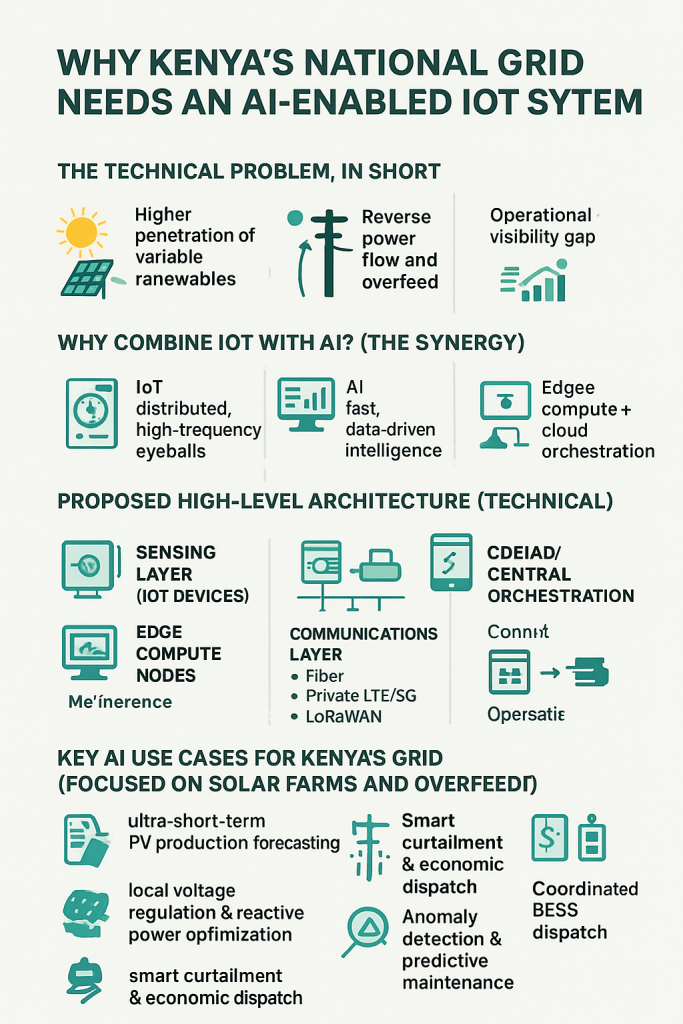
The technical problem, in short
- Higher penetration of variable renewables. Large solar farms (e.g., Garissa ~50–55 MW and several others in the 30–55 MW range) plus many distributed PV sources mean generation can swing quickly with cloud cover or rapid changes in irradiance. This increases frequency and voltage control challenges for both transmission and distribution operators. (Rural Electrification Corp)
- Reverse power flow and overfeeding. When local solar generation exceeds local load (midday, low demand), power can flow back into the distribution network and toward transmission. Without active control this causes voltage rise, protection miscoordination, and equipment stress in transformers and lines, problems that manifest locally long before a system-wide blackout.
- Operational visibility gap. Traditional grid telemetry (SCADA at substations, limited smart meter coverage) is too sparse and slow to see rapid, geographically localised events (cloud transients, inverter responses, rooftop PV behaviour). That gap makes it hard to coordinate many small and large PV plants with legacy dispatch and secondary reserves. International studies and policy reviews recommend storage and smarter control to manage this variability. (IEA Blob Storage)
Why combine IoT with AI? (the synergy)
- IoT = distributed, high-frequency eyeballs. Low-cost sensors (voltage, current, frequency, power factor), smart inverters’ telemetry (MPPT status, reactive power capability), line and transformer temperature, and weather/irradiance sensors provide the high-resolution state needed at feeder and farm level.
- AI = fast, data-driven intelligence. Machine learning models (short-term irradiance/production forecasting, probabilistic state estimation, anomaly detection, and optimal control policies) convert IoT telemetry into actionable decisions.
- Edge compute + cloud orchestration. Latency-sensitive controls (inverter setpoints, local storage dispatch, feeder reconductoring decisions) run on edge nodes; longer-horizon planning (day-ahead scheduling, market offers, fleet-level optimisation) run centrally or in the cloud.
This combination moves the grid from “observe and react” to “predict and act” at multiple time scales: milliseconds (inverter control), seconds, minutes (frequency/voltage response), and hours–days (economic dispatch, storage scheduling).
Proposed high-level architecture (technical)
- Sensing layer (IoT devices):
- Smart meters at selected points (secondary substations, feeders).
- PMUs (phasor measurement units) or high-resolution SCADA upgrades at strategic nodes for dynamic visibility.
- Inverter telemetry feed (real-time active/reactive power, DC link, temperature).
- Environmental sensors (pyranometers, cloud cameras, distributed weather stations).
- Edge compute nodes:
- Deployed at major substations and at large solar farms.
- Run ML inference for ultra-short-term forecasting (seconds–10 minutes), local state estimation, and closed-loop control of inverters/storage.
- Implement grid-forming/grid-following logic and local voltage regulation.
- Communications layer:
- Hybrid network: fiber where available, private LTE/5G or microwave for remote farms, LoRaWAN for low-bandwidth distributed sensors.
- Time-synchronised telemetry (NTP/GPS) for coherent measurements across the system.
- Cloud / central orchestration:
- Fleet management, day-ahead scheduling, market clearing, and long-horizon optimisation.
- An ML training pipeline with labelled operational data to continually retrain forecasting and anomaly models.
- Control interfaces:
- Secure APIs to interact with inverter fleet, battery energy storage systems (BESS), demand response aggregators, and traditional generator governors.
- Operator dashboard with explainable AI outputs and recommended actions.
Key AI use cases for Kenya’s grid (focused on solar farms and overfeed)
- Ultra-short-term PV production forecasting (seconds → 30 minutes): Using sky cameras, irradiance sensors, and farm telemetry, ML models predict rapid drops or surges so edge controllers can pre-adjust inverter reactive setpoints or pre-charge/discharge local storage. This reduces sudden overfeed events and frequency excursions. (ScienceDirect)
- Local voltage regulation & reactive power optimisation: Distributed inverters and STATCOMs coordinated by edge ML to stabilise feeder voltages during reverse power flow, preventing voltage rise and tap-changer hammering.
- Smart curtailment & economic dispatch: Instead of blunt, manual curtailment, AI computes minimal, targeted curtailment schedules by farm and inverter to relieve network constraints while minimising lost renewable energy revenue.
- Coordinated BESS dispatch: Storage at farm or substation level can soak excess generation and provide ancillary services (frequency response, synthetic inertia). AI optimises charge/discharge with market signals and forecasted generation.
- Anomaly detection & predictive maintenance: AI flags inverter anomalies, hotspotting, or protection misoperations before failure — reducing downtime at solar farms and preventing grid incidents.
- Demand response orchestration: AI integrates flexible loads (industrial, commercial, aggregated residential) as a controllable sink during overfeed windows, effectively absorbing surplus PV and balancing local networks.
Concrete example: handling an overfeed event
- Scenario: At 11:30 a.m., cloud cover clears quickly; multiple solar farms and rooftop PV push the distribution feeder into net export, causing voltage at a substation to rise above permissible limits.
- AI+IoT response flow:
- Fast irradiance spike detected by sky cameras and pyranometers at the farms; edge forecast predicts +60% generation in 90 seconds.
- Edge controller pre-emptively instructs inverters to provide more reactive absorption (VAr control), and signals local BESS to start charging at a calculated rate.
- If voltage still trends high, AI issues targeted curtailment signals to specific inverters whose curtailment causes least economic loss.
- Simultaneously, demand-response aggregator is notified to ramp up controllable loads for a short window.
- Result: Voltage excursion avoided, equipment protected, and energy loss minimised.
Implementation considerations (practical, regulatory, cybersecurity)
- Communications reliability & latency: Use deterministic links for primary control paths (fiber / private LTE) and redundant channels for robustness.
- Standards & interoperability: Conform to IEC 61850 for substation communications, IEEE 2030.x for smart inverter functions, and use secure MQTT/OPC UA for telemetry.
- Cybersecurity: Zero-trust architecture, hardware root-of-trust on edge nodes, encrypted telemetry, and strict role-based access. Grid control is critical infrastructure — security must be primary.
- Data governance & privacy: Define ownership (generator, utility, aggregator) and retention policies; anonymise consumer meter data where used for ML.
- Regulatory & market changes: EPRA/Kenya Power rules will need to allow dynamic setpoints, fast curtailment contracts, and compensation frameworks for curtailed renewables and BESS services. Pilot zones can validate technical and commercial models before wide rollout. (Kenya Power)
- Cost & ROI: Start with high-impact nodes (major solar farms, substations with frequent voltage issues) — pilots demonstrate reduction in curtailment, avoided equipment stress, reduced outages, and monetised ancillary services.
Conclusion — the business & system case
Kenya’s renewable build-out, including multiple multi-tens-of-MW solar farms and a fast-growing distributed PV fleet, creates both opportunities and operational risks for the national grid. An AI-enabled IoT system provides the sensing, prediction, and automated control needed to: (a) prevent and manage overfeed and voltage issues, (b) reduce curtailment and lost renewable energy, (c) coordinate storage and demand response for ancillary services, and (d) provide operators with actionable, explainable recommendations. International and local energy reviews already highlight the need for storage and smarter control as variable renewables grow; integrating AI+IoT is the pragmatic next step to convert Kenya’s abundant solar into reliable, dispatchable clean power while protecting grid assets and customers. (IEA Blob Storage)
